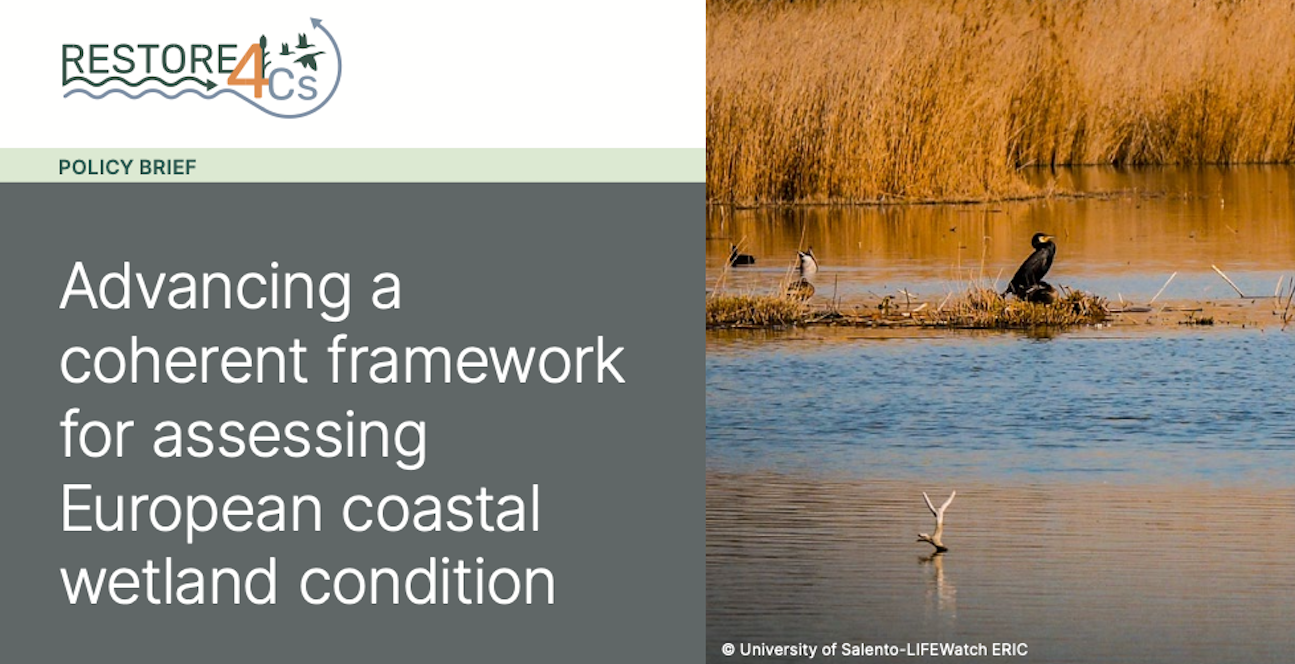
RESTORE4Cs has released Policy Brief 9, “How Can Coastal Wetland Restoration Mitigate Climate Change? What We Know and What Is Still Unclear”, alongside a new global meta-analysis preprint examining how coastal wetland restoration affects carbon storage and greenhouse gas (GHG) pathways.
Coastal wetlands, including saltmarshes, seagrass meadows, mangroves, and brackish or freshwater coastal wetlands, are among the most powerful natural carbon sinks on Earth. However, a key policy-relevant question remains: does restoring these ecosystems reliably improve the net climate balance, without increasing methane (CH₄) or nitrous oxide (N₂O) emissions?
What the Global Meta-Analysis Shows
Researchers from across the RESTORE4Cs consortium synthesised 66 peer-reviewed field studies, covering 257 restored-altered comparisons worldwide.
Key findings include:
- Restoration increases carbon stocks in soils/sediments and in above and belowground biomass.
- Changes in CO₂, CH₄, and N₂O fluxes after restoration were not statistically significant on average, indicating no systematic “GHG penalty”.
- Evidence remains uneven across regions and wetland types, limiting confidence in transferring results to under-studied contexts, including much of Europe.
Implications for European Climate and Restoration Policy
Policy Brief 9 translates these scientific findings into insights relevant for climate policy, restoration planning, and carbon accounting. It highlights three major gaps in the current evidence base:
- A strong geographical imbalance, with most studies focused on tropical mangroves and limited data from temperate European wetlands.
- An uneven focus on climate parameters, as carbon stocks are measured far more often than GHG fluxes.
- Limited harmonisation of monitoring and reporting, constraining comparability and use in EU-level climate reporting.
Key Messages
- Coastal wetland restoration is a credible nature-based climate solution.
- Current evidence does not show consistent increases in CH₄ or N₂O emissions following restoration.
- Europe urgently needs targeted monitoring and a harmonised MRV framework to fully and credibly account for climate benefits.
Further Readings and Resources
EarthArXiv preprint: Coastal wetland restoration and greenhouse gas pathways: A global meta-analysis (DOI: 10.31223/X51B39)
Read and download the 9th Policy Brief in the Case Pilot languages (Romanian, Portuguese, Dutch, Lithuanian, French, and Spanish) here.
Read the full RESTORE4Cs 9th Policy Brief below: